Dajti Mountain National Park: Nature at Tirana’s Doorstep
A newly approved Business Plan for Dajti Mountain National Park, prepared with support from UNDP through the EU4Nature programme, provides a practical roadmap for strengthening the Park’s financial sustainability and supporting implementation of its 2024–2034 Integrated Management Plan. By assessing the financing needs of the Management Plan’s Action Plan, examining existing and potential revenue sources, estimating the financing gap under different scenarios, and proposing measures to mobilize additional resources and use them more efficiently, the Business Plan helps connect the Park’s management and conservation ambitions with the financial resources needed to deliver them.
Rising immediately to the east of Albania’s capital, Dajti Mountain National Park provides a unique meeting point between a major urban centre and a protected mountain landscape. Its proximity to Tirana has made the Park one of the country’s most important destinations for recreation and nature-based activities, while its forests and ecosystems have earned it the familiar description of the “green lung” of the capital. Visitors can reach the Park easily by road or cable car and enjoy hiking, cycling, picnicking, outdoor sports and educational activities, alongside its rich natural, cultural and historical values.
The Park also encompasses Bovilla Lake, a reservoir located approximately 15 kilometres northeast of Tirana that plays an essential role in supplying drinking water to the capital. Surrounded by steep mountain terrain, the lake is distinguished by its aquamarine waters and dramatic landscape. In recent years, Bovilla and its surrounding viewpoints have also developed into a major visitor attraction, further diversifying the recreational and tourism experiences associated with Dajti Mountain National Park.
Dajti also holds a special place in the history of protected areas in Albania. Designated on 16 February 1960, it was the country’s first national park. Its protected territory was expanded in 2006 to 29,216.9 hectares and is classified as an IUCN Category II protected area, extending across the regions of Tirana and Durrës. The mountain forms one of the defining features of Tirana’s landscape, with Mount Dajti rising to 1,613 metres above sea level and the highest point of the massif, Maja e Meçekut, reaching 1,827 metres.
The 2024–2034 Integrated Management Plan
A new Integrated Management Plan 2024–2034 for Dajti Mountain National Park has recently been approved and is now in place, providing an updated strategic framework for the conservation, management and sustainable development of the Park. Covering a ten-year period, the Plan sets out the management objectives and priorities that will guide the administration of the protected area.
The Plan’s long-term objective is to “protect the Park’s natural biodiversity, its underlying ecological structure and supporting environmental processes in accordance with IUCN Category II standards, while promoting recreational and educational activities based on responsible tourism and supporting the development of local communities”. It therefore brings together conservation, responsible use of the Park and benefits for surrounding communities within a single long-term management framework.
An integral part of the Management Plan is its Action Plan, which translates these objectives into concrete actions and provides the basis for their implementation and monitoring. Together, the Management Plan and Action Plan establish both the long-term direction for Dajti Mountain National Park and the practical measures required to achieve its management objectives.
Closing the Financing Gap: The Business Planning Approach
To support the implementation of the newly approved 2024–2034 Integrated Management Plan, UNDP, through the EU4Nature programme, supported the preparation of a Business Plan for Dajti Mountain National Park, which was subsequently approved by the National Agency of Protected Areas (NAPA). The Business Plan was developed as a practical financial planning tool to help translate the priorities and actions of the Management Plan into realistic financing requirements, while identifying opportunities to strengthen the financial sustainability of the Park.
Its overall aim is to support the successful implementation of the Management Plan within existing financial constraints, while identifying opportunities to mobilize additional resources and providing practical recommendations for strengthening the Park’s financial sustainability. At the centre of this approach is the concept of closing the financing gap between the resources required to implement the Management Plan and those currently available to finance its priorities.
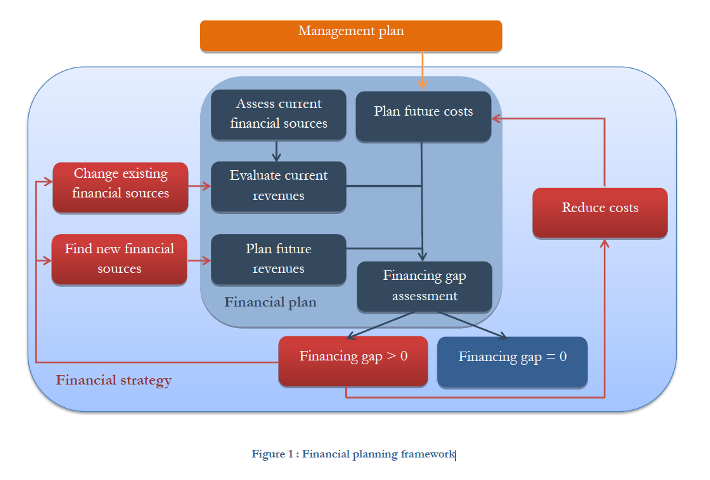
The analysis began with an indicative costing of the Management Plan’s Action Plan, estimating the financial resources required to implement its proposed actions. The resulting costs were then analysed and grouped according to their level of priority and nature of expenditure, providing a clearer understanding not only of the overall financing requirement, but also of which interventions are most important and the types of resources needed for their implementation.
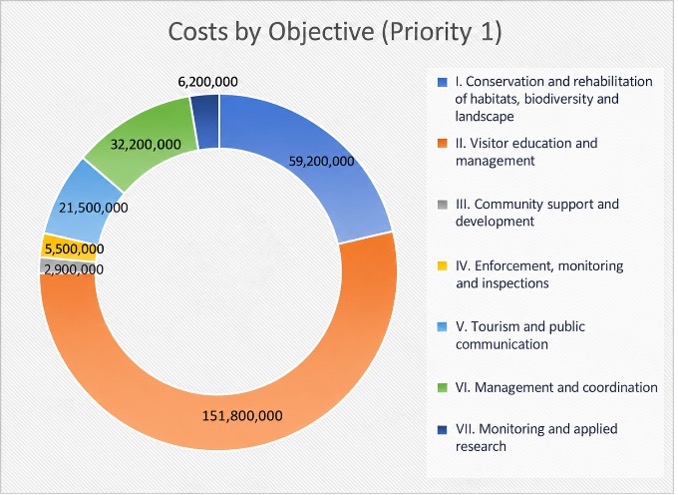
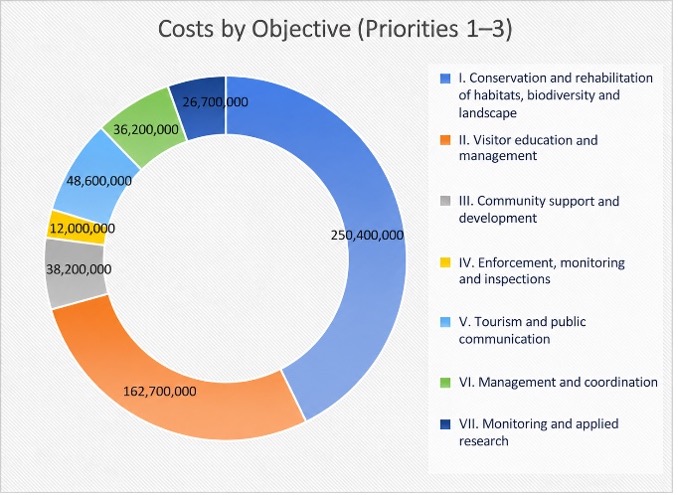
The indicative costing of the Action Plan demonstrates the scale of the additional resources required to support its implementation. Under the baseline scenario, which includes only activities classified as Priority 1, the total incremental cost for the ten year period is estimated at ALL 279.3 million, equivalent to approximately ALL 28 million per year, or around EUR 300,000 annually. Under the optimal scenario, which assumes implementation of activities across Priorities 1, 2 and 3, the estimated incremental financing requirement rises to ALL 574.8 million, more than twice the baseline requirement and equivalent to approximately EUR 600,000 per year. The difference between the two scenarios illustrates the importance of prioritization: while the baseline identifies the resources required for the Park’s most critical actions, the optimal scenario provides an indication of the financing needed for a more comprehensive implementation of the Management Plan.
On the revenue side, the Business Plan similarly develops two scenarios. The baseline revenue scenario assumes that the Park continues to generate revenues broadly at current levels, while the optimal revenue scenario assumes the gradual implementation of measures proposed by the Business Plan to improve existing revenue sources and develop new ones. These include revising entry fees, improving and expanding fee-collection mechanisms and points (like for Bovilla Lake), regulating fee collection from visitors entering through the Dajti cable car, introducing a Nature Fee linked to accommodation within the Park, and expanding revenue-generating ecotourism services. Under these assumptions, the optimal scenario projects annual revenues of approximately ALL 34.3 million, an increase of ALL 16.2 million, or around 90 percent, compared with the baseline scenario. Together, these measures demonstrate the potential to substantially increase the Park’s own revenue generation and contribute to narrowing the financing gap.

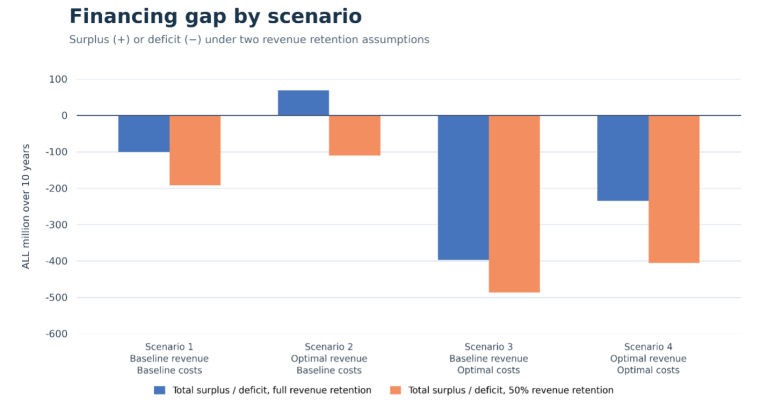
The expenditure and revenue projections were then brought together to estimate the financing gap under four combinations of costs and revenues: baseline expenditure (Priority 1) with baseline revenues; baseline expenditure with optimal revenues; optimal expenditure (Priority 1-3) with baseline revenues; and optimal expenditure with optimal revenues. This allows the Business Plan to assess both the financing gap under current conditions and the extent to which stronger revenue generation could support different levels of Management Plan implementation.
The analysis also considered the implications of the existing revenue-allocation framework. Alongside the assumption that all revenues generated by the Park are retained for its financing needs, the Business Plan assesses the results where only 50 percent of generated revenues are retained by the Park, with the remaining share contributing to the wider protected-area financing system, including support for underfunded protected areas and the Special Fund for emergency needs.
The financing-gap analysis highlights one of the Business Plan’s key findings: strengthening revenue generation is necessary for improving the Park’s financial sustainability and can make a material difference to implementation of the Management Plan. At current revenue levels, even implementation limited to Priority 1 actions faces a financing gap. However, if the proposed revenue measures are implemented and the Park, the optimal revenue scenario can generate sufficient resources to cover the incremental costs of Priority 1 actions.
The Business Plan recognizes that revenue generation alone cannot finance the full implementation of the Management Plan. It therefore recommends stronger interinstitutional coordination, so that activities falling partly within the mandates of municipalities, sector ministries and other public institutions can be financed through their respective budgets and programmes rather than entirely through protected-area resources. It also recommends early and structured engagement with donors and development partners, matching specific Action Plan priorities with potential external financing opportunities. For remaining needs that cannot be financed through park revenues or donor support, projects should be incorporated into the Medium-Term Budget Programme and annual State Budget.
On the expenditure side, the Plan recommends going beyond the existing Priority 1–3 classification by selecting activities according to their impact-to-cost ratio, giving preference to interventions capable of delivering significant conservation, social or management benefits at relatively low cost. Non-critical activities can also be phased or postponed when financing is constrained, while actions essential to biodiversity conservation and the basic functioning of the Park should be protected. Finally, costs can be reduced through economies of scale and greater operational synergies. Activities with a horizontal character, such as training, capacity building and work related to legal and regulatory frameworks, can in some cases be implemented jointly across several protected areas rather than separately for Dajti.
Taken together, the recommendations establish a progressive financing strategy rather than reliance on any single source of funds: increase and diversify park revenues first; mobilize complementary financing from public institutions, donors and the State Budget; prioritize expenditure according to impact and urgency; and reduce costs through phasing, coordination and synergies. This provides a practical pathway for progressively closing the financing gap while ensuring financing for the Management Plan’s most important conservation and management priorities.
Supporting the Successful Implementation of the Management Plan
The Business Plan is not a stand-alone financial exercise. It was developed specifically to strengthen the implementation of the 2024–2034 Integrated Management Plan, by translating its objectives and actions into financing requirements and identifying practical ways to mobilize and use the resources needed to deliver them. Through the preliminary costing of the Action Plan, prioritization of financing needs, assessment of existing and potential revenues, analysis of the financing gap and development of practical recommendations, the Business Plan provides the Park Administration and NAPA with a financial framework for moving from management objectives to implementation.
The preparation of the Business Plan is also itself a specific action of the Management Plan. Under the objective of promoting sustainable tourism practices that generate mutual benefits for conservation and local communities, Action 2.3.1 calls for the development of a coherent Park Business Plan with a purposeful model for the use of Park revenues for conservation. The availability of a Park Business Plan is also identified as a corresponding result indicator. The preparation and subsequent approval of the Business Plan therefore represent a concrete step in implementing the Management Plan itself, while establishing the financial planning framework needed to support its wider implementation.
Through this support EU4Nature has helped address both an immediate commitment of the Action Plan and a broader implementation need. The approved Business Plan provides a practical pathway for progressively closing the financing gap and strengthening financial sustainability, so that revenues generated through the sustainable use and enjoyment of Dajti Mountain National Park can increasingly contribute to the conservation, management and long-term objectives for which the Park is protected.