Biodiversity Digital Twins and the Future of Nature Conservation
Imagine being able to anticipate how a forest may change over the coming decades, how a bird population may shift in response to climate change, or where an invasive alien species may spread before its presence becomes a serious management concern on the ground.
This is the idea behind one of the emerging technological developments in nature conservation, known as the biodiversity digital twin. A digital twin is a virtual representation of a real object, process or system. The technology was initially developed for industrial applications, where digital models were created for machinery, buildings and transport systems. Researchers are now adapting the same concept to far more complex natural systems including forests, wetlands, habitats and entire ecosystems.
Unlike a conventional map or database, a digital twin does not simply display existing information. It combines regularly updated data, ecological models and advanced computing capacity to simulate how a natural system may respond to future change.
How a biodiversity digital twin works
At its core, the technology brings together multiple sources of information within a single digital environment. These may include field observations, satellite data, land-use maps, climate data, acoustic recordings, camera-trap data, animal-tracking devices and citizen-science observations.
These data feed into ecological models designed to represent relationships among species, habitats and environmental factors. As new information becomes available, the model can update its projections.
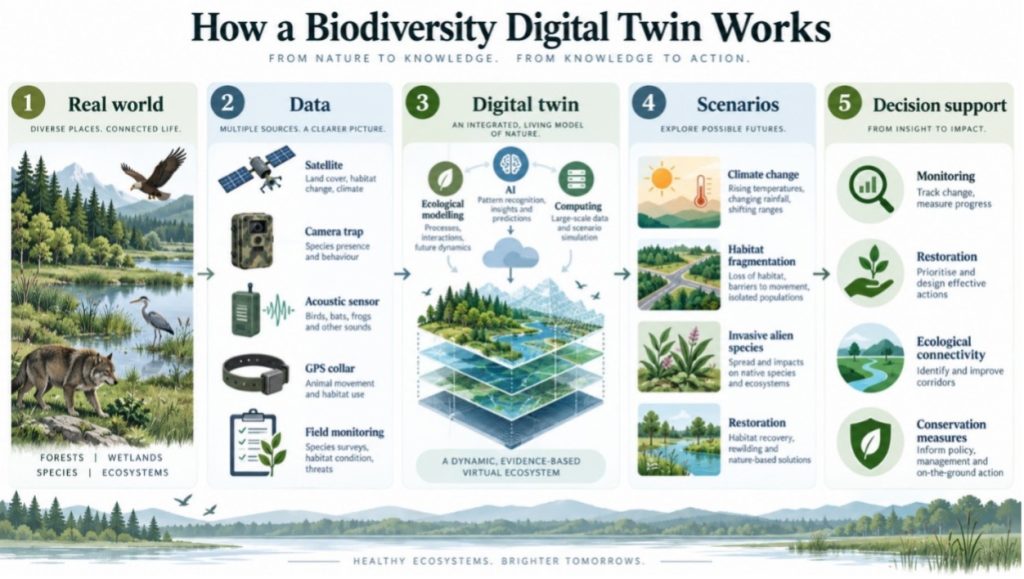
This is what distinguishes a digital twin from a traditional static model. A species distribution map may show where a species has been recorded today. A digital twin aims to assess where that species may occur in the future and how climate change, habitat fragmentation or human pressures may influence its distribution.
The term should not, however, be understood as implying a perfect digital copy of nature. Ecosystems are highly complex and no model can reproduce every ecological interaction. A biodiversity digital twin is a simulation and decision-support tool rather than a substitute for field monitoring, ecological expertise or evidence-based conservation management.
From reacting to impacts towards anticipating risk
Much biodiversity management remains reactive. Institutions often intervene after a population decline has been detected, a habitat has been degraded or human–wildlife conflict has already emerged.
Predictive technologies aim to change this approach. By combining near-real-time monitoring with ecological modelling, digital twins may help identify emerging changes before their consequences become difficult or impossible to reverse.
The European NATURE-FIRST initiative has developed models designed to forecast sturgeon breeding periods in the Danube Delta, assess the risk of human–bear conflict and analyse changes in the movement patterns of large carnivores. The purpose is to help direct patrolling, monitoring and preventive measures towards locations and periods where risks are expected to be highest.
This shift from reaction towards anticipation may be particularly relevant for protected areas, where human and financial resources are often limited. A system capable of identifying higher-risk locations could help protected area administrations better target patrols, monitoring efforts and restoration measures.
Examples currently being tested in Europe
The European BioDT initiative developed ten biodiversity digital twin prototypes addressing forest and grassland dynamics, bird monitoring, ecosystem services, invasive alien species and the genetic resources of wild relatives of cultivated plants.
One prototype uses bird vocalizations collected through a mobile application. Artificial intelligence supports species identification, while the model combines these observations with historical records, climate information, land cover and forest structure. Outputs are presented through updated maps and visualizations of bird distribution and activity.
Another prototype assesses the potential spread of invasive alien plants across different European habitats. It integrates information on climate, land cover, habitats, roads and railways to estimate where the risk of biological invasion may increase under current and future environmental conditions.
These examples show that the technology can be applied at different ecological scales. A digital twin may represent a single species, a group of species, a habitat or a broader ecosystem.
What digital twins could offer nature management
One of the main advantages of biodiversity digital twins is their potential to test different scenarios without experimenting directly in natural ecosystems.
A protected area manager could examine how a habitat might respond to rising temperatures, declining water levels, increasing visitor numbers or a proposed restoration measure. A planner could compare alternative locations for ecological corridors. An authority responsible for invasive alien species could identify areas where early detection and monitoring should be prioritised.
In the marine environment, the European Union is also developing a Digital Twin of the Ocean designed to integrate observations and models in order to simulate the effects of pollution, climate change and human activities on marine ecosystems and aquatic environments.
In principle, these systems could improve restoration planning, monitoring of conservation status, assessment of pressures and threats, and the selection of management measures. In practice, however, the quality of their outputs depends directly on the quality, coverage and compatibility of the underlying data and models.
Promising technology that still has limitations
The growing interest in biodiversity digital twins should be accompanied by caution. Biodiversity is monitored unevenly. For some species, long-term datasets are available, while for many others the available information remains fragmented, outdated or entirely absent.
Data may be stored in different formats, follow incompatible standards, or be collected at different spatial and temporal scales. Models can also reproduce the limitations, gaps and biases of the datasets on which they are built.
Researchers working through BioDT have identified fragmented data, interoperability between systems and operational complexity among the main barriers to moving from experimental prototypes towards fully functional systems.
Some current prototypes explicitly remain research tools and are not yet intended for direct operational decision-making.
There are also broader questions concerning data ownership, protection of sensitive information on threatened species, transparency of algorithms and the capacity of institutions to maintain technologically demanding systems once research funding comes to an end.
A window into the future of nature conservation
Biodiversity digital twins will not replace biologists, protected area rangers, field monitoring or the knowledge held by local communities. Their value lies in their capacity to bring these different sources of information together and translate them into scenarios that can support better-informed decisions.
The technology is still developing, but the direction is increasingly clear. Nature conservation is gradually moving beyond static maps and periodic reporting towards systems capable of integrating new data, analyzing ecological change and anticipating emerging risks.
The challenge is therefore not simply to develop increasingly sophisticated models. The more important challenge is to ensure that these systems are built on reliable data, remain transparent about uncertainty and ultimately help practitioners make better conservation and management decisions on the ground.
Further reading:
BioDT and biodiversity digital twin prototypes
https://biodt.eu/
Official European Commission information on BioDT
https://cordis.europa.eu/project/id/101057437
Research on integrating data and models in biodiversity digital twins
https://www.nature.com/articles/s44185-025-00116-3
Research on near-real-time biodiversity forecasting
https://www.nature.com/articles/s41559-025-02966-3
NATURE-FIRST results on digital intelligence for biodiversity conservation
https://cordis.europa.eu/article/id/464166-digital-intelligence-and-forensics-prevent-biodiversity-loss
Author: EU4Nature Team