Editorial
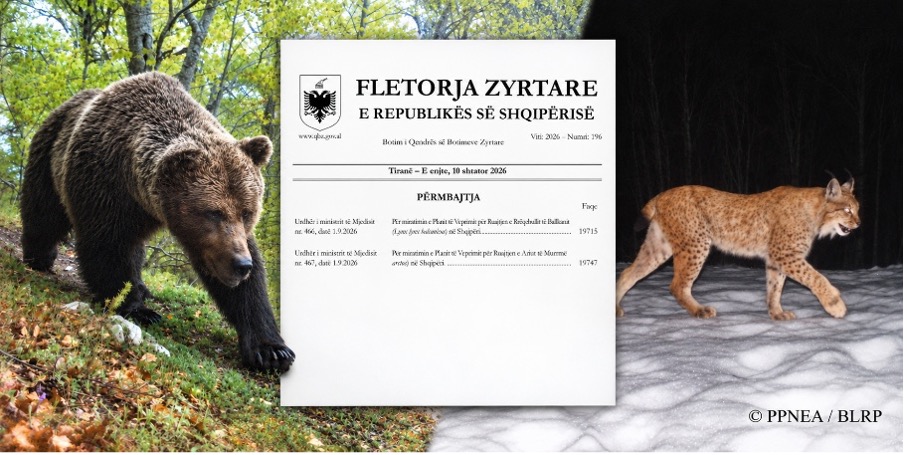
The conservation of threatened species requires more than legal protection. It depends on reliable scientific knowledge, clear objectives, coordinated institutional action and practical measures that address the pressures affecting species and their habitats. Species action plans bring these elements together, translating the priorities established in biodiversity strategies into measurable conservation actions.
In this issue of the EU4Nature Bulletin, we give particular attention to an important achievement for species conservation in Albania: the approval of the updated Action Plans for the Balkan Lynx (Lynx lynx balcanicus) and the Brown Bear (Ursus arctos). Prepared under the EU4Nature project by the Albanian Center for Flora and Fauna Research at the Faculty of Natural Sciences, the plans were approved by the Minister of Environment and published in Official Gazette No. 196, dated 10 September 2026, covering the implementation period 2026–2031.
The two plans are comprehensive revisions of the action plans originally prepared in 2007. They retain the principal conservation objectives of the earlier documents while incorporating the scientific, legal, institutional and management developments that have taken place over the last 18 years.
Their approval also represents an important step in implementing Albania’s biodiversity policies and strengthening alignment with European nature-conservation requirements. Biodiversity strategies establish the broader objectives for protecting species, habitats and ecosystems, while species action plans translate those objectives into targeted measures, responsibilities, implementation periods and monitoring requirements. They therefore provide an important connection between strategic commitments, protected-area management and conservation action in the field.
For the Balkan Lynx, the updated plan integrates new scientific and monitoring information, including the findings and recommendations of the Balkan Lynx Recovery Programme. It provides updated assessments of the species’ population, distribution and genetic condition and gives increased attention to habitat restoration, ecological connectivity, the recovery of natural prey populations, the reduction of human-related mortality and coordinated regional conservation. These measures are particularly important for a species whose remaining population is small, fragmented and dependent on cooperation across the countries of the southwestern Balkans.
The updated Brown Bear Action Plan similarly reflects improved knowledge of the species’ distribution and population status. It incorporates changes resulting from the strengthened institutional responsibilities within the National Agency of Protected Areas and the Regional Administrations of Protected Areas, and closer alignment with European Union nature-protection legislation. The plan also includes more developed measures for habitat restoration, monitoring and the management of human–bear conflicts, while recognising that Albania’s bear population forms part of a wider regional population.
The approval of these plans is not the end of the process. Their contribution to biodiversity objectives will depend on coordinated implementation, adequate institutional capacity, systematic monitoring and regular reporting on progress. Cooperation among national and regional authorities, scientific institutions, civil-society organisations and local communities will be essential. The measures contained in the plans must also be reflected in the management of the protected areas where these species occur.
EU4Nature is now supporting the next stage of species conservation action planning. Preparatory work has begun for two additional national action plans, covering the Eurasian Otter (Lutra lutra) and the Egyptian Vulture (Neophron percnopterus). Their selection has been endorsed by the National Agency of Protected Areas and is consistent with Article 26 of Law No. 9587, dated 20 July 2006, “On Biodiversity Protection”, as amended, which provides for the preparation of conservation action plans for specially protected species with an unfavourable conservation status.
The Eurasian Otter is closely associated with rivers, wetlands and other aquatic ecosystems. Its recorded presence in areas including Dajti, Shebenik and Vjosa makes a dedicated action plan important for addressing the conservation of its populations and habitats together with the pressures affecting freshwater ecosystems. The Egyptian Vulture requires particular conservation attention because of its threatened status and its presence in six EU4Nature pilot areas: Vromoner, Dajti, Vjosa, Hotovë-Dangëlli, Zagori and the Shala Valley. Its action plan will provide a national framework for coordinated monitoring, habitat conservation and the reduction of the main threats affecting the species.
Together, these action-planning processes demonstrate how biodiversity strategies can be translated into practical and accountable implementation. The next priority is to ensure that the approved plans guide institutional work programmes, protected-area management, monitoring activities and biodiversity reporting. Through consistent implementation and review, they can become effective instruments for improving the conservation status and securing the long-term survival of Albania’s most vulnerable wildlife.
EU4NATURE TEAM