NEWSROOM
From Monitoring to Reporting: Aligning Species and Habitat Data with EU Directives
Effective biodiversity conservation depends not only on protecting species and habitats in the field, but also on the ability to monitor, interpret, and report ecological data in a structured and policy-relevant manner. For countries advancing toward alignment with the EU environmental acquis, this link between monitoring and reporting is particularly critical, as compliance with the EU Birds and Habitats Directives requires consistent, evidence-based information on species status, habitat condition, pressures, and trends.
Within the framework of the EU4Nature project, Albania has taken important steps to strengthen this link by improving protected area monitoring practices and aligning them with EU and international standards. Recent Management Effectiveness Tracking Tool (METT-4) assessments across pilot protected areas confirm progress in operational processes and enforcement, while also highlighting persistent gaps in planning, biodiversity outcomes, and long-term ecological monitoring. These findings underline a central challenge: without standardized and comparable biodiversity data, improvements in management effectiveness cannot be fully translated into credible reporting under EU directives.
Building a Common Monitoring Language
One of the key constraints identified through the METT assessments is the uneven integration of monitoring results into management and reporting processes. While many protected areas collect valuable field observations, the absence of harmonized formats has limited their use for national-level analysis and EU-compatible reporting. To address this gap, EU4Nature supported the development of standardized species and habitat monitoring formats, designed to be practical for daily use by Regional Administrations for Protected Areas (RAPA) staff, while remaining fully aligned with Natura 2000 and METT-4.
These formats establish a common monitoring language across protected areas, ensuring that data collected in different sites can be aggregated, compared, and interpreted in a consistent way. By moving beyond ad-hoc notes and unstructured observations, standardized formats allow routine field monitoring to contribute directly to evidence-based management and policy reporting.
What a Standardized Monitoring Format Should Contain
For monitoring data to support EU reporting obligations, formats must capture more than species presence alone. They must systematically document what is observed, where and when it is observed, under which conditions, and what this means for management.
The monitoring formats developed under EU4Nature therefore include several core elements that are essential for EU alignment. Each observation is clearly traceable through the recording of date, time, location, protected area, and observer identity, ensuring transparency and allowing trends to be tracked over time. Species and habitats are identified using both common and scientific names, and—where applicable—recognized classification systems such as EUNIS codes, ensuring compatibility with Natura 2000 reporting requirements.
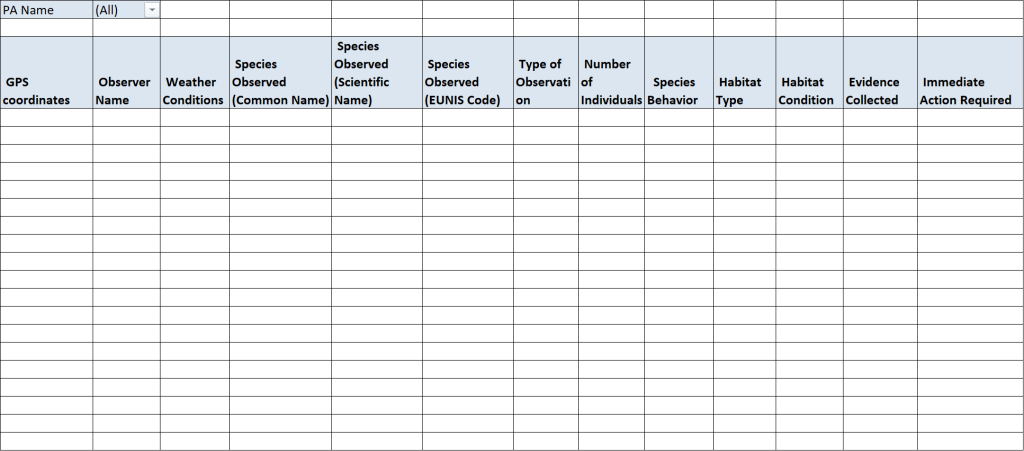
Importantly, the formats capture habitat condition and ecological status, rather than simple presence or absence. Structured categories describing habitat quality and observable changes make it possible to detect early signs of degradation or recovery, supporting the requirements of the Habitats Directive related to avoiding deterioration and assessing conservation status.
Equally critical is the systematic recording of pressures and threats, including illegal activities, habitat degradation, pollution, infrastructure development, invasive species, and fire. By documenting both the type and perceived severity of threats, monitoring data can be directly linked to enforcement actions, mitigation measures, and management priorities.
To strengthen data credibility, the formats allow for the inclusion of supporting evidence, such as photographs, GPS references, camera trap images, or field notes. Finally, each monitoring record explicitly links observations to management relevance, including recommended follow-up actions. This ensures that monitoring data feeds directly into adaptive management, rather than remaining a purely descriptive exercise.
Designed for integration with digital tools such as SMART and centralized databases, these formats ensure that field-level observations can flow seamlessly into national monitoring systems, METT assessments, and EU-compatible reporting processes.
Two Complementary Levels of Monitoring
The monitoring framework promoted under EU4Nature is based on a two-tiered approach. At the first level, specialized monitoring is conducted by external biodiversity experts using scientific methodologies such as transects, camera trapping, targeted surveys, remote sensing, and other advanced techniques. These assessments provide the level of rigor required for formal reporting under the EU Nature Directives.
At the second level, incidental monitoring is carried out by RAPA field staff during routine patrols and site visits. While not a substitute for systematic scientific surveys, this continuous presence in the field allows staff to identify emerging threats, habitat changes, and notable species observations. When captured through standardized formats and integrated into centralized databases, incidental monitoring functions as an early-warning system, guiding where and when more detailed expert assessments are needed.
From Field Data to EU-Compatible Reporting
Aligning monitoring data with EU reporting obligations depends on data consistency, quality, and traceability. The standardized monitoring formats and databases developed under EU4Nature ensure that field observations are compatible with European classification systems and reporting logic, allowing data to be consolidated at national level and used to support reporting under the Birds and Habitats Directives.
Crucially, the integration of monitoring data with METT-4 strengthens the connection between management effectiveness and ecological outcomes. While METT results show improvements in inputs and processes, outcome indicators related to biodiversity recovery remain modest. Systematic species and habitat monitoring provides the ecological evidence needed to assess whether improved management is translating into tangible conservation results.
Strengthening Adaptive Management
A core principle of the EU Nature Directives is adaptive management, whereby conservation measures are regularly reviewed and adjusted based on monitoring results. By embedding monitoring data into planning and decision-making processes, protected area authorities are better equipped to prioritize restoration actions, strengthen enforcement, and refine management plans.
The METT assessments indicate that planning remains one of the weakest elements across several protected areas, despite gains in enforcement and capacity. Integrating standardized monitoring data into planning cycles is therefore essential to ensure that management plans remain relevant, responsive, and aligned with both national conservation priorities and EU requirements.
Looking Ahead
The transition from monitoring to reporting is a continuous process rather than a one-off exercise. The systems and tools developed under EU4Nature represent a significant step toward a nationally coordinated biodiversity monitoring and reporting framework. By combining standardized field formats, centralized databases, and internationally recognized assessment tools, Albania is strengthening its capacity to demonstrate conservation performance in line with EU standards.
Ultimately, aligning species and habitat data with EU directives is not only about compliance. It is about building a robust, credible evidence base that supports better decision-making, enhances transparency, and ensures that conservation efforts deliver measurable benefits for biodiversity, ecosystems, and local communities.