Project VjoSusDev 2022-2026 – Update overview
Briefly on the Project VjoSusDev 2022-2026
University of Tirana is leading the APPEAR VjoSusDev project (2022-2026), focused on the environmental assessment of the Vjosa riverscape as the basis for an integrated water management and sustainable catchment development. It aims at a comprehensive, interdisciplinary and inter-institutional and long-term scientific study between three Albanian universities: Faculty of Natural Sciences (Departments of Biology and Chemistry), University of Tirana (UT); Faculty of Geology, Polytechnic University (UPT); and Agricultural University of Tirana (UBT); and three Austrian universities: University of Vienna; University of Natural Resources and Life Sciences – BOKU, Vienna; University of Innsbruck. The project is funded by the Austrian Development Agency (ADA) under the APPEAR program (Austrian Partnership Programme in Higher Education and Research for Development) and facilitated by the Austrian Agency for Education and Internationalization (OEAD) (https://oead.at/de/kooperationen/internationale-hochschulkooperationen/austrian-partnership-programme-in-higher-education-research-for-development-appear/projects/current-projects/project251-vjosusdev ).
The study is focused on the assessment of hydrodynamic connections (sediments, hydrogeology, floods, erosion, etc.), river biodiversity (algae, river flora and vegetation), water quality (physico-chemistry, nitrogen and phosphorus nutrients, heavy metals, organic pollutants, PAH, PCB and OCP, and microbiology, coliforms, etc.). Some activities were partially supported and in synergy with the ESPID4VJOSA project (2022-2024) (https://ecoalbania.org/espid4vjosa-zhvillimi-i-nderlidhjes-se-shkences-dhe-institucioneve-vendimmarrese-per-vjosen/?lang=en), implemented by the Euronature/Ecoalbania consortium, and supported by the Austrian Development Agency (ADA).
Aims of the Project
─ Comprehensive, catchment- orientated research program as a basis for an in-depth evaluation of management options, in the light of Sustainable Development goals.
─ Provide evidence-based guidance towards integrated management of a valuable water resource to ensure its long-term use.
─ Mutual strengthening of an interdisciplinary and translational approach at all involved research institutions.
Main Work packages, WPs & Study River reaches
There are 4 cross-cutting research topics (Work packages, WPs), and related working groups working in an interdisciplinary and translational approach: WP 1: Monitoring and understanding the fundamental physical regime governing the Vjosa riverscape; WP 2: Maintaining the Vjosa riverscape´s ability to support biodiversity; WP 3: Ecosystem dimensions behind clean water provisioning, a key fluvial ecosystem service; WP 4: Science and Society interactions for sustainable development.
Regular assessments are going on in 10 river segments (hydrodynamics and river biodiversity) (Fig. 1). Up to 23 stations were designated for water quality (Fig. 2), of which 13 stations are undergoing regular assessments every 2 months to monthly by chemists and microbiologists. The stations represent river habitats not only of the Vjosa River, but also of its tributaries, Drino, Shushica, Bença, Kardhiqi, Zagoria, Langarica and Sarandaporos.
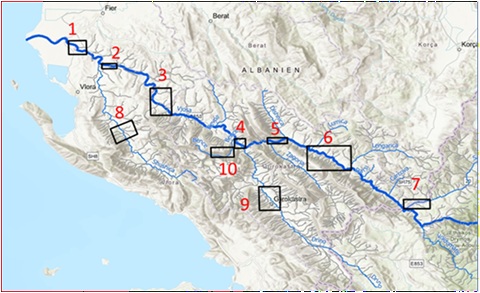
Figure 1. The map of the study river reaches under the VjoSusDev Project. Vjosa 1, meandering stretch (Mifoli, rkm 19-29, length 10 km); Vjosa 2, (upstream of the Shushica confluence, rkm 41-50; 9 km); Vjosa 3 (Poçemi-Kalivaçi, rkm 68-78; 10 km); Vjosa 4 (Tepelena); Vjosa 5 (Kelcyra downstream, rkm 118-124; 6 km); Vjosa 6 (Permeti upstream, rkm 131-150; 19 km); Sarandoporos 7 (rkm 0-9; 9 km); Shushica 8 (rkm 30, 4 km); Drino 9 (rkm 21-34; 13 km); Bença 10 (rkm 5-14; 9 km).
The study follows the work started several years ago (2014) with most of the experts and the same institutions, to protect the Vjosa River from dams, but this time in a more regular and extended approach in time and space. It was a long-standing international campaign led by NGOs like EuroNatur (Germany), Riverwatch (Austria) and Ecoalbania as part of the Save the Blue Heart of Europe initiative (https://www.balkanrivers.net/en ), which aims to protect free-flowing rivers in the Balkans. On March 13th, 2023, the Albanian government declared the Vjosa and its tributaries (Drino, Bença and Shushica) as Wild River National Park (Category II according to the IUCN and Albanian law) (DCM 155/2023). There are about 12,727 ha, including the whole aquatic, riverscape area (more than 400 km of riverine flow in total) (https://www.vjosanationalpark.al/ ). It is a status that permanently prohibits dam projects and development within its boundaries; the designation will safeguard the entire ecosystem, including tributaries and floodplains, making it a key contribution to the EU Green Deal and Biodiversity Strategy.
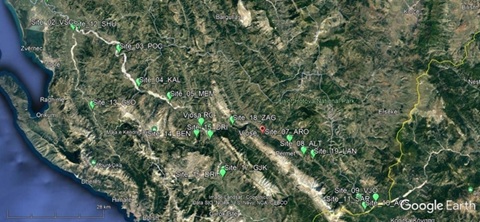
Figure 2. Map with 23 WP3 Water Quality Stations. Site_01_MIF, Vjosa River, Mifoli Bridge; Site_02_VSC, Vjosa River above the confluence with Shushica (Mesaraku); Site_03_POC, Vjosa River, Poçemi Bridge; Site_04_KAL, Vjosa River at Kalivaçi; Site_05_MEM, Vjosa River, downstream Memaliaj at the confluence with Luftinja; Site_06_DRA, Vjosa River upstream the confluence with Drino, near Dragoti; Site_07_ARO, Vjosa River at Hotel Aroma, downstream Permeti; Site_08_ALT, Vjosa River at Albturist, upstream Permeti; Site_09_VJO, Vjosa River just where it reaches Albania; Site_10_AOS, Vjosa/Aoos River at the Greek border; Site_11_SAR, Sarandoporos River at the Tre Urat border post; Site_12_SHU, Shushica River, before joining the Vjosa (Picari); Site_13_GJO, Shushica River downsteram the Gjormi village; Site_14_BEN, Bença River, at the Ali Pasha Aqueduct Bridge; Site_15_DRI, Drino River, before joining the Vjosa (Lekli); Site_16_KDQ, Kardhiqi River, before joining the Drino (Andon Poçi); Site_17_GJK, Drino River, downstream Gjirokastra, above joining the Kardhiqi River (Andon Poçi); Site_18_ZAG, Zagoria River, before joining the Vjosa; Site_19_LAN, Langarica River, before joining the Vjosa; Site_20_KDQ_up, Kardhiqi River, upper part; Site_21_Kroi-Bratit, Çajupi, Kroi i Bratit; Site_22_ZAG-up, Zagoria River, at the Doshnica Waterfall, Zhej; Site_23_DRI-GJIR, Drino River, in Gjirokastra (downstream Towns Bridge).
The Vjosa Research Center Fritz Schiemer (VRC) (Fig. 3) was established in Tepelena at the riverbanks of Vjosa, on September 25th, 2020, as a joint initiative of professors from the Department of Biology of the University of Tirana and the working experts in Albania of the campaign ‘Save the Blue Heart of Europe’. It is currently under the administration of the Ecoalbania Center (https://ecoalbania.org/vjosa-research-centre/). The house functions as a science hub in the region and offers accommodation and working facilities for students and senior scientists from Albania and abroad. Experts suggest that VRC and its Name could be included in the future Vjosa Multifunctional Centre planned to establish in Tepelena by the Albanian Government.
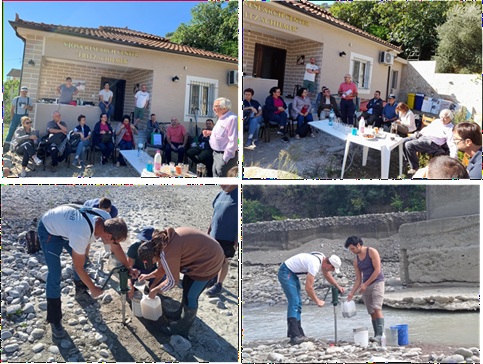
Figure 3. Research visit in Vjosa – September 19th-24th, 2022: above, working meeting in Vjosa Research Center ‘Fritz Schiemer’, Tepelena (https://vjosa-research-centre.ecoalbania.org/); below, data sampling in Vjosa.
VjoSusDev activities
Regular weeks of field trips were spent in Vjosa and Vjosa Delta during 2022-2025, either from each WP group in wet season (spring) and dry season (late summer); only chemists and microbiologists visited the region 4-6 times per year. Most of samples and other collected material in the field are processed, analyzed or still under examination process, in the related labs, by each separated WP group or in cooperation, either in Albania or Austria. About 10 MSc students from Albanian or Austrian universities sustained or in process in their master degrees; 4 PhD students are working either in Austria or Tirana. More than 10 published / presented contributions to academic conferences and related proceedings or papers (i.e. Karaman, 2023; 2024a,b; 2025; Malicky & Graf, 2024; Martini et al., 2023; Murányi & Kovács, 2023; 2024; Schöffmann et al., 2022; Schwarz & Dobbelsteijn, 2024; Schwingshackl et al., 2024; Shumka et al., 2023; Teufl & Graf, 2024; etc.). More than 10 joint activities: WP representatives presented the VjosSusDev project outcomes either in Tirana, Vjosa region or Vienna; translating it into basic information finding the most proper means to communicate, exchange and discuss with governmental institutions, the local representatives, and NGOs in Albania (e.g. AMBU, NAPA, NEA, and related affiliated local agencies, VBMP & VWRNPMP experts, EcoAlbania, etc.); as well as raise the knowledge base for decision making and public and institutional awareness on water governance; about 10 writings in local newspapers, TV interviews, podcasts dedicated to Vjosa issues and VjosSusDev project.
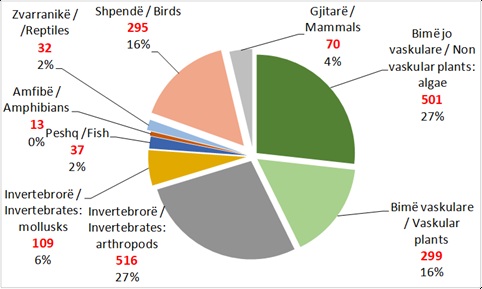
Figure 4. Updated graph on biodiversity on Vjosa Wild River NP. (Data from Meulenbroek et al., 2020; updated by Miho, -; Bino et al., 2023; and Shumka et al., 2018).
Updated data on habitats & biodiversity on Vjosa Wild River NP
Up to now there are noted 16 habitat types in the riverbed of the Vjosa river, at low to mean flow, maintained by periodic flood conditions: 7 aquatic habitats (A1-A7); 3 terrestrial habitats within the active channel (AC) on coarse grained sediments (B0-B2); 3 terrestrial habitats within the AC on fine grained sediments (C0-C2); 2 habitats at elevated islands within the AC and on the floodplains (BC3 & BC4); and 1 degradation habitat (D). Four are priority habitats after FFH-Annex I/Natura 2000, EUNIS habitat classification 2004/2012 and EU Red List (Schiemer et al., 2020): Gravel/sand bars (3220; C3.62; VU); Initial vegetation (3250; C3.553; VU); Mediterranean riparian scrub (92D0; F9.31; LC). More than 1,820 species are known for the Vjosa River to date (750 plants and 1,072 animals) (Fig. 4); ca 40 species are endangered according IUCN, and 119 are on the Albanian Red List (2013). 148 species are listed in Annex 1–3 of the Berne Convention; 41 species in the Bird Directive; 78 species in the Habitats Directive (Meulenbroek et al., 2020; updated by Miho, -; Bino et al., 2023; and Shumka et al., 2018).
Some exiting examples: Vjosa river and its pristine tributaries are the last refuge of the almost extinct, rare or new invertebrates species (Fig. 5). The stonefly Isoperla vjosae (Plecoptera) is first decribed as new species for science from Poçemi waters, Vjosa River (Graf et al., 2018); Vjosa River is the last refuge of the almost extinct tiny but mighty mayfly Prosopistoma pennigerum (Ephemeroptera,); it is suggested as the flagship species for the Vjosa Wild River NP by Schwingshackl et al. (2024). Additionally, the amphipods (crustacean) Niphargus griebleri, N. lepushensisare reported as new for science by Karaman (2023 & 2025 respectively); the amphipod genus Fingerhadziaand species Fingerhadzia zorae also reported as new (Karaman 2024b); in addition, another amphipod species, Salentinella angelieri was first described for Albania (Karaman 2024a); all were from subterranean (interstitial) waters of the upper part of River Shushica. Two other new species for science were recently recorded: Protonemura eclyisis (Plecoptera) from Bença River (Teufl & Graf 2024), and Oxyelhira eichelmanni (Trichoptera) in undisturbed torrent in Tepelena (Malicky & Graf, 2024). Further descriptions of new species are in progress.
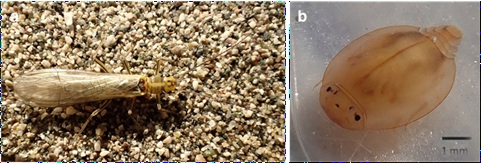
Figure 5. b, The stonefly Isoperla vjosae (Plecoptera) a new species for science from Poçemi waters, Vjosa River (Graf et al., 2018); b, Vjosa River is the last refuge of the almost extinct tiny but mighty mayfly Prosopistoma pennigerum (Ephemeroptera,), suggested as the flagship species for the Vjosa Wild River NP by Schwingshackl et al. (2024).
Experts from each group are working on manuscripts with detailed descriptions of scientific findings and more in-depth interdisciplinary discussions, which will be part of a special volume dedicated to the Vjosa River.
Science-Society interactions for sustainable development – important events
Several facts are worth to note related with Science and Society interactions for sustainable development where VjoSusDev experts were involved: The Vjosa Wild River National Park – A Management Plan – the VjoSusDev data were considered in March 2024. AMBU & EU4Rivers Project – participation in meetings (June, October 2024 & February 2025) and workshop (October 2024). AKZM & EU4Nature – Key Species Status Update & Inventories, and Vjosa Park is selected as PA pilot, January 2025.
Statement of Scientists: Water abstraction project on Shushica river (Lepusha spring, Kuçi; Himara Water Supply Project)- Review of the Environmental and Social Impact Assessment (ESIA) of the Water Supply component within the Water Supply Program – prepared and signed by 24 scientists in January, 2024. Scientific evidence and the basic requirements for an EIA – a letter sent to German Embassy BMZ in Berlin, KfW, WBIF and other relevant stakeholders in Albania in 20 February 2024. The Shushica – ecological risks of the water abstraction project, information sent to lawyer for Lepusha case in December 2024. The IUCN Report the mitigation hierarchy on Shushica, during the past summer – as cooperation with VjoSusDev experts and other experts, in January 2025 (Döbbelt-Grüne et al., 2025a&b).
Science Weeks in the Pishë Poro – Narta Protected Landscape (April 2023, April 2024, April-May 2025). The International Vjosa Delta Symposium – An Ecosystem in Transition (Vlora, October, 2023). Vjosa Delta Volume, printed & online versions – Promoting ceremony, April 23d, 2025, FNS, UT (Miho et al., 2024; https://fshn.edu.al/Info/delta-vjose ).
Some ecosystem disturbs
Strong erosion, urban, agricultural, oil spill pollution: High turbidity of Vjosa and TSS values (especially in tributaries) as evidence of the strong erosion in the area – bare areas, the scarce plant cover (only 22%) and the forests. Excessive use of riverbanks for construction and agricultural land. High content of nutrients (N & P), organic pollution (PAHs, PCBs, OCPs), and organic matter, micro- & macroplastics, coliforms green nitrophilous algae, cyanobacteria (some also toxic) – Vjosa, Drino (Gjirokaster – Lekli), Kardhiqi (Bridge), Bença (Tepelena) – high content of – untreated waters: urban, agriculture livestock and aquaculture & poor solid waste management. Observed crude oil spills and leaching from old industrial infrastructure directly into the Vjosa near Poçemi.
Significant water abstraction for agricultural irrigation is particularly observed in the Fieri and Gjirokastra lowlands; it has led to reduced river flows and negatively impacted the ecosystem of the Vjosa Wild River National Park, threatening its ecological integrity and biodiversity.
Other observations in the zone – unfriendly urbanization: Growing urban & touristic infrastructure close to the riverbanks and other hydromonuments; River mining (Shushica).
Threats to nature conservation in Shushica River: Himara Water Supply Project – Big concern from experts and environmentalists: Protection of the Lepusha Spring, in Shushica.
The Vjosa Delta – an indivisible part of the Vjosa/Aoos Wild River National Park (VWRNP): Vjosa Delta area was ignored in the zoning process of the new Vjosa Wild River NP. The protecting state of the existing PA Landscape Protected Pishe Poro – Narta (Vth cathegory) was reduced and partially mitigated by DCM 694/2022 (Fig. 2). Vlora Airport was constructed within the protected zone. There are tourist infrastructure development plans in the area, supported also from the amendments of the existing Law on PAs (Law 21/2024).
Recommendations on the Vjosa River Basin Management Plan & the Vjosa Wild River NP Management Plan
Integrated Management Plans are strongly suggested: Defining Critical Areas; Surveying the Vjosa Basin to Inventory the Critical Areas; Prioritizing Pollutants, Sources and Causes.
Decrease the pollution from point & non point sources: Waste water treatment: with centralized or decentralized/distributed systems for areas outside the sewage system; Solid waste management: urban solid waste disposal sites; incineration; Environmental friendly detergents; Collection and treatment of hospital waste; Control the oil spills and leaching from old industrial infrastructure; Treatment of industrial waters; etc.
Sustainable use of natural resources water, sun, forests… & Sustainable tourism: Sustainable water use: Drainage & irrigation system; Drinking water supply system; Bottled water; Ban river mining; Sustainable energetic system: HPPs, Solar; grid-connected photovoltaic’s; Forestry: forest nurseries and forestation; voluntary work; livestock structure; Sustainable tourism – Responsible tourism; Ecotourism; Nature Positive Tourism; Family tourism; Agro tourism; Cultural & Heritage tourism; Culinary tourism; Hiking & Nature tourism; etc.
Sustainable agriculture, livestock…: Quality of crops, cereals, vegetable, fruit- & vineyards; Farming; Processing; Organic farming, etc.; Agro-industry; Harvest, cultivation and trade of aromatic-medicinal plants; Crafts; Livestock structure; Ban the goat keeping; Soft loans for: Agriculture and livestock; Agro-industry; Aromatic-medicinal plants; Crafts; Family tourism; etc.
Sustainable Management of Fisheries, Aquaculture and Hunting: Fishery & Aquaculture; Sportive fishing & sustainable aquaculture; Conservation of important river habitats in accordance with 1st protection category according to IUCN criteria; Adaptation of hunting legislation to that of the EU; Ban hunting; etc.
The Vjosa case, a model for cooperation between management and research.
The required next steps: Develop a comprehensive “monitoring board“ between governmental institutions and science; Develop and maintain international research cooperation on water management issues; Develop an international research program on the Vjosa Delta area; Develop a science – policy bridge.
Author: Prof. Dr. Aleko Miho